
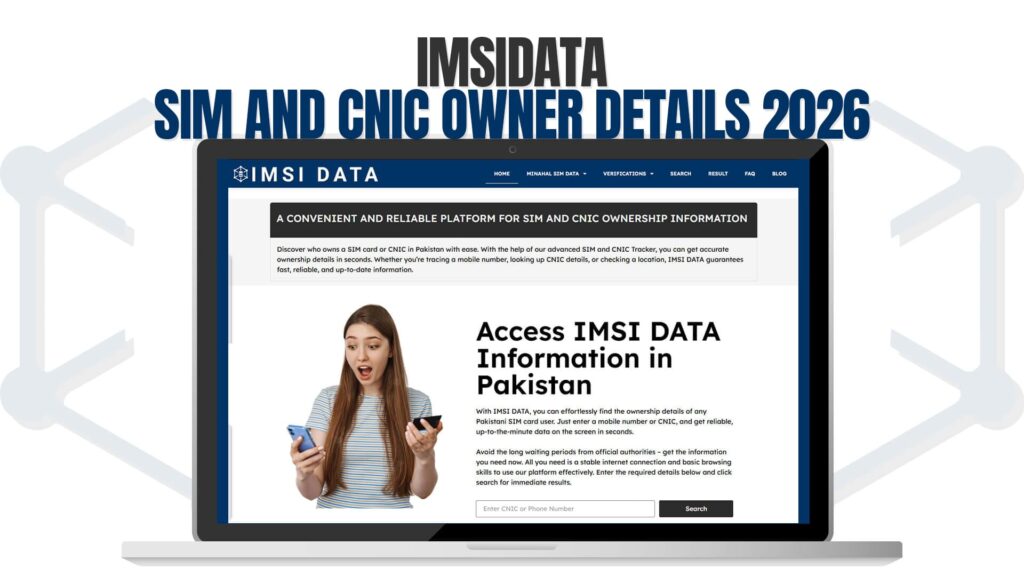
In our connected world, knowing who is on the other end of a phone call or message is not just convenient; it’s often a matter of safety and security. In Pakistan, with millions of mobile phone users, the need for a reliable, official system to verify SIM and CNIC ownership is critical. This is where IMSIData comes in.
IMSIData is the common term for the database managed by the Pakistan Telecommunication Authority (PTA) that links every active mobile phone SIM card in the country to the Computerized National Identity Card (CNIC) of its verified owner. Think of it as a massive, secure digital directory. Its primary purpose is to curb illegal activities like anonymous harassment, fraud, and terrorism by ensuring every number can be traced back to a real, verified person.
As we move into 2026, the importance of this system has only grown. With increasing online transactions, digital banking, and e-commerce, verifying a phone number’s legitimacy is a key step in preventing scams. Whether you’re a business verifying a customer, an individual trying to identify an unknown caller, or someone who has lost a phone, access to IMSIData provides a layer of security and peace of mind that is invaluable in today’s digital Pakistan.
Understanding the Basics: SIM, CNIC, and IMSI
To understand how IMSIData works, let’s break down the key terms:
SIM (Subscriber Identity Module): This is the small chip you put in your phone. It has a unique number that identifies you to the mobile network. This number allows you to make calls, send texts, and use mobile data.
CNIC (Computerized National Identity Card): This is the official ID card for every Pakistani citizen. It has a unique 13-digit number. It is the primary document for all legal and official purposes in the country.
IMSI (International Mobile Subscriber Identity): This is a unique 15-digit code stored on your SIM card. It is the true international identity of a mobile subscriber. While your phone number can be changed or ported between networks, the IMSI is permanently tied to your SIM. The IMSIData system is fundamentally built around tracking this IMSI and linking it to a CNIC.
The government of Pakistan, through the PTA, made it mandatory for all mobile network operators (like Jazz, Zong, Telenor, and Ufone) to register every SIM against a user’s verified CNIC.
This created the massive, centralized IMSIData database. When you use a service like IMSIData, you are querying this official, PTA-approved system to find the ownership link between a mobile number and an identity.
The Official Channel: PTA and Its Role in IMSIData
The Pakistan Telecommunication Authority (PTA) is the sole official regulator and guardian of the IMSIData system. They do not provide direct public access to the full database for privacy and security reasons. However, they have established official methods for citizens to verify and check their own registered SIMs.
The primary official method is the PTA SIM Information System 2026. You can access this service by:
Sending your CNIC number (without spaces) via SMS to 668.
Using the official “PTA SIM Information App” available on Google Play Store and Apple App Store.
Visiting the PTA’s official website and using their web portal.
These official channels allow you to see how many SIMs are registered on your own CNIC. This is a crucial security check to ensure no one has fraudulently registered a SIM in your name.
Important Note: Services that claim to provide full SIM owner details (like name, address, etc.) for any random number through a simple online search are NOT directly provided by PTA. Platforms that offer such services act as intermediaries, using officially sanctioned APIs or methods for specific, lawful purposes, often for businesses and organizations. When we refer to IMSIData in this guide, we are talking about the concept and the ecosystem of verified access to this ownership data through proper channels.
How to Responsibly Use IMSI and SIM Owner Information
Access to such sensitive data comes with great responsibility. It is vital to use IMSIData services only for legal, ethical, and legitimate purposes.
Legitimate Uses Include:
Verifying Your Own SIMs: Checking how many numbers are registered under your CNIC to identify and report any fraudulent ones.
Business Verification: A company verifying the identity of a new client or customer during a transaction.
Security Checks: Identifying unknown or harassing callers where your safety is concerned.
Finding Lost Phones: If your phone is lost or stolen, knowing the official registration details can help in filing a precise police report and getting the SIM blocked.
Family Safety: Parents verifying the numbers in contact with their children.
Illegal and Unethical Uses Include:
Harassing or stalking individuals.
Using the information for blackmail or fraud.
Violating someone’s privacy without just cause.
Selling or distributing the data to third parties.
Misuse of personal identity information is a serious crime in Pakistan under the Prevention of Electronic Crimes Act (PECA) 2016 and can result in heavy fines and imprisonment. Always ensure your purpose for seeking IMSIData is lawful.
A Step-by-Step Guide to Accessing SIM Owner Details (2026)
While the PTA’s 668 service is for self-check, other needs require different approaches. Here is a general guide on how to access ownership details through authorized platforms:
1. For Checking Your Own Registered SIMs (Official & Free):
Via SMS: Take your mobile phone. Write your 13-digit CNIC number (e.g., 4220112345678). Send it to the short code 668. You will receive an SMS reply listing all mobile numbers (from all operators) registered on your CNIC.
Via PTA App: Download the “PTA SIM Information App.” Register using your CNIC and phone number. You can view your registered SIMs, their status, and even block any suspicious ones directly through the app.
2. For Verifying a Number’s Owner (Through Authorized Services):
This is where services that provide access to IMSIData come into play. The process is typically straightforward:
Visit a Reliable Platform: You would go to a trusted service provider’s website or platform.
Enter the Mobile Number: Input the 11-digit Pakistani mobile number you wish to verify.
Authentication & Purpose: You will likely need to authenticate yourself and state your legitimate reason for the query. This is a security and compliance step.
Receive Information: If the query is approved, the system will return the CNIC information to which that mobile number is registered. The details are sourced from the official PTA IMSIData system.
Important Reminder: Always use trusted and compliant services. Be wary of any website or app that promises instant, unlimited results without any verification—these are often scams designed to steal your money or data.
Benefits of Using a Compliant IMSIData Service
Using a proper, authorized service to access IMSIData offers significant advantages:
Accuracy and Reliability: The data comes directly from the official PTA-linked database, ensuring it is up-to-date and correct.
Enhanced Security: It helps combat spam calls, fraud attempts, and anonymous threats by revealing the registered identity.
Business Efficiency: Companies can streamline customer onboarding (KYC – Know Your Customer), reduce fraud, and build trust.
Personal Safety: Provides a tool for individuals to verify unknown contacts, especially in online marketplaces like OLX or Facebook Marketplace.
Peace of Mind: Knowing you can verify identities creates a safer digital environment for everyone.
Yes, but with important conditions. It is 100% legal to check the SIMs registered on your own CNIC using the official PTA methods (SMS to 668 or the PTA app). Checking the owner details of another person’s mobile number is legally restricted. It is only permitted for specific, lawful purposes (like business verification or security concerns) through authorized platforms that follow strict compliance and data protection laws. Using such information for harassment or illegal activity is a serious crime.
For a completely free method, you can only check numbers registered to your own CNIC via PTA’s 668 service. There is no official, completely free public directory to find the owner of any random Pakistani mobile number. Authorized services that query the IMSIData system typically involve a fee to cover operational and compliance costs. Be cautious of websites offering “free SIM database checks,” as they are often unreliable or malicious.
IMSIData is the comprehensive database system that stores the link between all SIM IMSI numbers and citizen CNICs. The PTA 668 service is one specific, free tool provided by the PTA that allows citizens to query only their own data from this vast database. Think of IMSIData as the entire library and 668 as a self-service kiosk that lets you look up only the books checked out in your own name.
This is a serious issue of fraudulent SIM registration. You must take immediate action:
Block the SIM: Use the PTA SIM Information App to immediately block the fraudulent number.
Contact Your Mobile Operator: Call the customer service of the relevant network (Jazz, Zong, etc.) and report the fraudulent SIM registered on your ID.
File a Complaint with PTA: You can formally complain through the PTA’s complaint portal on their official website.
Report to FIA: For serious cases, you can file a complaint with the Federal Investigation Agency’s (FIA) Cyber Crime Wing.
No. Even through authorized IMSIData services, the primary information retrieved is the CNIC number and the name associated with it that is registered to the mobile number. A full address or family details are not part of the standard SIM registration data accessible through these channels. More detailed demographic information is held solely by the National Database and Registration Authority (NADRA) and is protected by much stricter laws.
Conclusion: Navigating a Secure Digital Pakistan with IMSIData
As we advance through 2026, the IMSIData system remains a cornerstone of digital security and identity verification in Pakistan. It empowers citizens to protect themselves from fraud, helps businesses operate more securely, and aids law enforcement in maintaining a safe cyberspace.
The key is to use this powerful tool responsibly. Always start with the official, free PTA services for your personal checks. For other legitimate needs, seek out reputable and compliant platforms that provide access to IMSIData within the bounds of the law. By doing so, you contribute to a more transparent, secure, and trustworthy digital ecosystem for all Pakistanis.
Disclaimer: This article is for informational purposes only. The methods and services described are based on publicly available information as of 2026. Always use the official PTA channels for personal verification and ensure any third-party service you use for SIM information is fully compliant with Pakistani law. Misuse of personal data is illegal.