
Every Pakistani citizen above the age of 18 has a Computerized National Identity Card, commonly known as a CNIC. This card is not just an ID — it is tied to your bank accounts, property records, tax filings, SIM cards, voting registration, and dozens of other official processes.
Because so much is connected to one card, knowing how to check CNIC ownership details in Pakistan has become genuinely useful. Whether you are verifying a business partner, confirming someone’s identity before a transaction, or simply checking your own records, there are several legitimate and easy ways to do this.
This guide walks through every major method available in Pakistan, explains when you might need them, and covers what tools like DB Center can add when you are dealing with phone-based identity concerns alongside CNIC queries.
What Is a CNIC and Why Does Ownership Verification Matter?
A CNIC is a 13-digit identification number issued by NADRA — the National Database and Registration Authority. The format looks like this: XXXXX-XXXXXXX-X. The first five digits represent the district of issuance, the next seven are a unique personal number, and the last digit indicates gender.
The card holds your full name, date of birth, photograph, father’s name, and home address. When all of this is tied together under one number, verifying who actually owns a CNIC becomes a matter of both security and trust.
Here is why people check CNIC ownership details in Pakistan:
Property Transactions. When buying land or a house in Pakistan, you want to confirm that the person selling is who they claim to be. Fraudulent property deals are unfortunately common, and verifying a seller’s CNIC upfront can save enormous trouble later.
Business Agreements. Before signing a contract or entering a partnership, confirming your counterpart’s identity through their CNIC is a basic due diligence step.
Employment Checks. Many companies in Pakistan ask candidates to submit their CNICs, and HR teams often verify these details before finalizing a hiring decision.
SIM Card Registrations. Under PTA regulations, every SIM card in Pakistan must be registered to a CNIC. If someone is using a number registered on your CNIC without your knowledge, that is a serious concern you need to address quickly.
Personal Security. With identity fraud on the rise, checking your own CNIC records periodically helps you catch any unauthorized registrations or misuse before they escalate.
Method 1: Check CNIC Details Through NADRA’s Official Website
NADRA maintains an official web portal that allows citizens to verify CNIC-related information. Here is how to use it:
Go to verisys.nadra.gov.pk — this is NADRA’s official verification system. The portal is designed for businesses and individuals who need to verify identity documents.
On the Verisys portal, you can enter a CNIC number and confirm basic details like the name registered to that number, their date of birth, and whether the card is currently active or expired.
This service is widely used by banks, insurance companies, hospitals, and private businesses across Pakistan. For individual users, access may require registering an account. For larger-scale verifications, NADRA offers paid API access for businesses.
The portal does not give you a stranger’s full personal profile — and that is by design. Pakistani privacy law and NADRA’s own data governance policies limit what can be accessed publicly. What you do get is enough to confirm whether a CNIC number is valid and whether the name on it matches what someone has told you.
Method 2: CNIC Verification via SMS
For many people in Pakistan, especially outside major cities, SMS-based verification is the most accessible option. NADRA offers a simple service:
Send your CNIC number to 8300.
Within a few moments, you will receive a reply confirming the name registered to that number. The response comes back in plain text, and it is fast — usually within 30 seconds on most networks.
This works on all major Pakistani networks including Jazz, Telenor, Zong, and Ufone. A small fee is charged per SMS, typically deducted from your prepaid balance.
The SMS method is particularly useful when you are not near a computer. If someone hands you a CNIC during a transaction, you can do a quick check on the spot before proceeding.
Method 3: Visit a NADRA Office or E-Sahulat Center
For more detailed verification, or if you want official documentation of your own CNIC records, visiting a NADRA office in person remains the most thorough option.
NADRA has offices in almost every major city and district across Pakistan. You can walk in with your original CNIC and ask for a data printout of your registered information. This is especially useful if you suspect your CNIC data has errors or has been misused.
NADRA’s E-Sahulat centers are smaller, franchise-style service points spread across towns and neighborhoods. They handle routine NADRA services including application renewals, data corrections, and basic verification. They are often faster than the main offices for simple queries.
If you have received any SMS about your CNIC being used for something you did not authorize, going in person and requesting a formal review is the right move.
Method 4: Check SIM Cards Registered on Your CNIC
This is one of the most commonly overlooked but genuinely important checks. Pakistani telecom regulations require SIM cards to be registered under a CNIC. Over time, unscrupulous dealers or identity thieves may register SIM cards under your CNIC without your knowledge.
The Pakistan Telecommunication Authority (PTA) provides a service to check how many SIMs are registered on your CNIC. Here is how:
Send your CNIC number to 668 via SMS.
You will receive a reply listing all SIM cards currently registered under your CNIC, including the network and number. If you see any numbers you do not recognize, you can report them to PTA or directly to the relevant telecom operator for deregistration.
This check costs a small SMS fee and takes under a minute. Everyone should do this at least once a year.
Understanding What DB Center Adds to This Picture
When the question goes beyond CNIC and involves a phone number — for example, if someone called you and you want to know who it was — that is where a service like DB Center becomes useful.
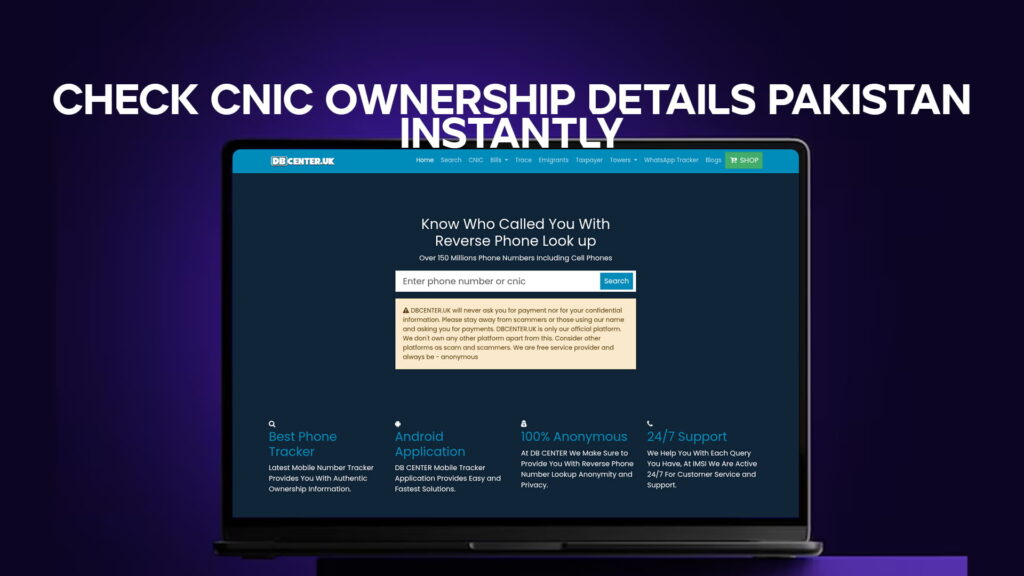
DB Center is a reverse phone lookup service with a database of over 150 million phone numbers, including mobile phones. You enter a phone number, and the system searches its records to identify who the number belongs to. The results can include the owner’s name, location data, and carrier information depending on what is available.
This is particularly relevant in Pakistan for a few practical reasons. Many scam calls come from numbers that are either unregistered or registered under fake identities. If you received a suspicious call from someone claiming to be from a bank, a courier company, or a government office, you can cross-check that number on DB Center before you hand over any personal information.
The combination of CNIC verification through official channels and phone number lookup through DB Center covers two angles of the same problem: confirming who someone is and making sure they are not misrepresenting themselves to you.
DB Center does not replace NADRA’s official verification tools. Think of it as a complementary layer — one that handles phone identity while NADRA handles document identity. Used together, they give you a more complete picture when trust is at stake.
How to Read CNIC Information Correctly
When you verify a CNIC and receive information back, it helps to know what you are looking at. Here is a brief breakdown:
The 13-digit CNIC number encodes location and personal data. The first five digits correspond to the issuing district. This means you can tell roughly where a person registered their CNIC just from the number itself.
The name on the CNIC is transliterated from the person’s Urdu name, which sometimes leads to variation in English spellings. Do not immediately assume fraud just because a name appears spelled differently across documents. Ask the person to show their original card.
The expiry date matters. CNICs in Pakistan are valid for 10 years. An expired CNIC can still be used for basic identification, but it should be renewed. If someone is presenting an expired card for a significant transaction, that warrants a closer look.
The photo on the card should match the person in front of you. NADRA has improved the quality and tamper-resistance of CNIC cards significantly over the years, but forgeries do exist. If you have serious doubts, the Verisys portal allows photo comparison for authorized users.
Legal Grounds for CNIC Verification in Pakistan
Checking your own CNIC details is always legal. Checking another person’s CNIC for a legitimate purpose — such as employment verification, business transactions, or property deals — is also permissible under Pakistani law, provided it is done through proper channels.
What is not legal is using someone else’s CNIC information for fraud, impersonation, or unauthorized access to their financial or personal accounts. The Prevention of Electronic Crimes Act (PECA) 2016 covers many forms of digital identity misuse in Pakistan, and penalties under it are significant.
NADRA’s systems are designed with this in mind. The Verisys system gives enough information to confirm identity without exposing complete personal profiles. This is a reasonable balance between accessibility and privacy.
If you suspect someone is misusing your CNIC — perhaps you received an alert about a bank account or property registration you did not authorize — filing a complaint directly with NADRA, FIA’s Cybercrime Wing, or your local police station are all valid options.
Common Signs That Your CNIC Information May Have Been Compromised
Identity fraud tied to CNIC data does happen in Pakistan, and catching it early makes a significant difference. Watch out for:
Receiving bank or credit-related correspondence you did not initiate. If a bank sends a welcome letter for an account you never opened, someone may have used your CNIC to register it.
Telecom alerts about SIM registration or porting you did not request. This is a precursor to SIM-swap fraud, which is used to bypass two-factor authentication.
Property-related notices or court documents arriving at your address for cases you have no knowledge of. In some fraud cases, property is registered using stolen or duplicated CNIC information.
Any message from NADRA confirming updates to your record that you did not request. Report these immediately.
If you use a service like DB Center and notice phone numbers linked to your name that you have never owned, that is also worth investigating through official NADRA channels.
Tips for Protecting Your CNIC Information
Being proactive about CNIC security is straightforward with a few basic habits:
Do not share your CNIC number on social media or in online chats, even casually. Treat it the way you treat your bank account number.
When submitting a CNIC photocopy for any purpose, write the purpose on the copy in pen — for example, “For XYZ Bank account opening — [date].” This prevents the copy from being reused for something else.
Check your SIM registrations at least once a year via the PTA SMS service. Deregister any numbers you no longer use or do not recognize.
Keep your CNIC address updated. NADRA allows address changes, and having an outdated address can lead to official correspondence going to the wrong place — including notices you need to respond to.
Renew your CNIC before it expires. An expired card, while technically still identifiable, can create complications in banking and legal procedures.
You can verify the name and validity of a CNIC number through NADRA’s official tools without necessarily having the person’s permission, as this is considered identity confirmation for legitimate purposes. However, accessing full personal profiles or using CNIC data for unauthorized purposes is illegal under PECA 2016. Always use official channels and have a genuine reason for the check.
Yes, the 8300 SMS service is available around the clock on all major Pakistani networks. The response time is typically under a minute. A small per-SMS charge applies, which is deducted from your prepaid balance or added to your postpaid bill.
As of current PTA regulations, a maximum of five SIM cards can be registered on a single CNIC across all networks. Biometric verification at telecom franchises is mandatory for new SIM registrations. If you find more than five SIMs linked to your CNIC, report this to PTA immediately.
Visit the nearest NADRA office or E-Sahulat center with supporting documents (birth certificate, family registration certificate, or court affidavit for name corrections). NADRA has a formal correction process. Minor errors like date discrepancies are usually resolved within a few working days. Larger corrections such as name changes may take longer.
Yes, this is one of the practical uses. If you receive a call from someone claiming to represent NADRA, a bank, or a government department and asking for your CNIC details, you can check the number on DB Center before responding. The reverse phone lookup can help identify whether the number belongs to a legitimate institution or has been flagged by other users. Never share your CNIC, OTP, or banking details over an unsolicited call regardless of what the caller claims.
Final Thoughts
Checking CNIC ownership details in Pakistan is not complicated once you know which tools to use. NADRA’s official services — the Verisys portal, the 8300 SMS line, and in-person offices — cover the core verification needs. The PTA’s 668 SMS service handles SIM-based checks, which is something everyone in Pakistan should run periodically.
For the phone side of identity verification, DB Center rounds out the picture with its reverse phone lookup service and database of over 150 million numbers. When you are dealing with unknown callers who want your personal information, having a quick way to check who is on the other end is worth having.
The most important thing is to use legitimate channels, stay aware of how your CNIC is being used, and act quickly if something does not look right. Your identity is worth protecting — and Pakistan now has enough digital infrastructure to make that protection genuinely accessible.