
You get a call from a number you’ve never seen before. No name, no context — just a string of digits on your screen. Do you pick up? Call back? Most people hesitate. And in today’s environment, that hesitation is completely reasonable. Scam calls, SIM fraud, and identity-linked phone crimes have made it necessary to think twice before engaging with any number you don’t recognize.
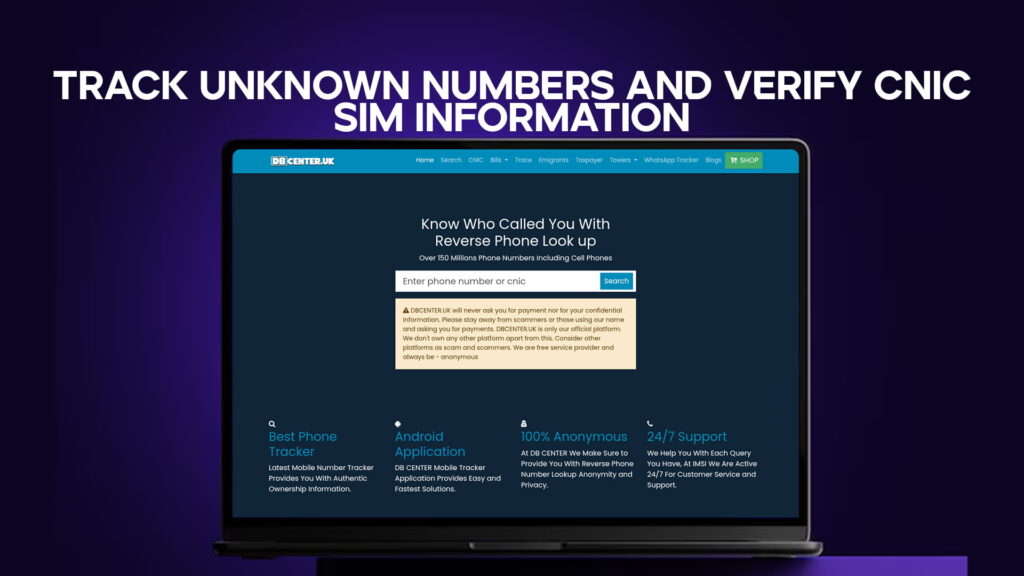
This article covers two things that are closely related: how to track unknown numbers and how to verify whether a SIM card is linked to a specific CNIC (Computerized National Identity Card). Both are legitimate, practical concerns — especially across South Asia, where SIM registration tied to national identity documents is standard practice, and where SIM fraud through unauthorized registrations is a real and growing problem. Platforms like DB Center, which cover over 150 million phone numbers including mobile numbers, give ordinary people access to the kind of information that was previously hard to find without insider contacts or official channels.
The Problem with Unknown Numbers Today
Unknown number calls have always been annoying. But what’s changed in recent years is the scale and sophistication of the problem. Scam operations now run at industrial levels. A single fraudulent call centre can dial thousands of numbers a day, using spoofed caller IDs, VoIP lines, and SIM cards registered under stolen identities to avoid being traced.
On the receiving end, the person who picks up just sees an unknown number. They have no way of knowing whether it’s a legitimate business, a wrong number, or an attempt to extract personal or financial information. Without a way to check who owns that number before calling back, most people are operating blind.
The consequences of engaging with the wrong number range from minor annoyance to serious financial loss. There are documented cases of people being defrauded by callers pretending to be bank representatives, government officials, or delivery companies. In many of these cases, the SIM used for the call was registered fraudulently — under someone else’s CNIC without their knowledge.
This is why both capabilities — tracking unknown numbers and verifying CNIC-linked SIM registrations — matter. They address two sides of the same problem.
What Does “Tracking an Unknown Number” Actually Mean?
When people say they want to track an unknown number, they almost always mean one of two things:
The first is identification — finding out who owns the number. Who is this person? What name is the SIM registered under? Is it a business or a private individual? Is this number associated with reported spam or fraud activity?
The second is location — finding out where the caller is. This is where a lot of confusion comes in, because real-time GPS-level location tracking through a phone number is not something a public reverse lookup service provides. That kind of tracking requires carrier-level access and is restricted to law enforcement operating with proper legal authority.
What a reverse phone lookup does — and does well — is give you identification data. You can find out who a number is registered to, what carrier it belongs to, what region it’s associated with, whether it’s a mobile or VoIP line, and whether other people have flagged it as a scam. For most purposes, that’s the information you actually need.
DB Center’s database covers over 150 million phone numbers and returns this kind of identification data quickly and clearly through its search and trace tools. For the vast majority of numbers people need to check, meaningful information is available within seconds.
CNIC and SIM Registration: Why It Matters
In Pakistan and several other countries in the region, mobile SIM cards must be registered against a valid national identity document. In Pakistan, that document is the Computerized National Identity Card issued by NADRA — the National Database and Registration Authority. Every SIM card activated on any Pakistani network is supposed to be linked to a valid CNIC.
The system was introduced to reduce anonymous phone use and make it harder for criminals to operate untraceable mobile lines. In theory, it means every mobile number has a real, verifiable owner.
In practice, the system has a vulnerability: SIM fraud. Fraudsters have been known to register SIM cards under other people’s CNICs without their knowledge — either through corrupt retailers, stolen identity documents, or social engineering. The victim’s CNIC ends up linked to SIM cards they never applied for and don’t know exist. These unauthorized SIMs then get used for anything from scam calls to banking fraud to criminal communications.
For ordinary citizens, the risk is real. If someone registers a SIM under your CNIC and uses it for fraud, you could end up associated with activities you had nothing to do with. At minimum, you could face complications if those numbers are ever investigated.
The ability to verify which SIM cards are registered against your CNIC — and to check the registration details behind any mobile number — is therefore not just convenient. It’s a basic form of identity protection.
How to Verify CNIC SIM Information
There are a few different angles to verifying SIM information linked to a CNIC.
Checking your own CNIC. The most important thing most people should do — and most haven’t — is check how many active SIM cards are registered under their own national identity number. In Pakistan, the Pakistan Telecommunication Authority (PTA) has made this possible through official channels, including an SMS-based service where you send your CNIC number to a designated short code and receive a list of all SIMs registered against it. If any of them are unfamiliar, you can report them immediately.
This is something everyone should check periodically, not just once. Fraudulent SIM registrations can happen at any time, and catching them early significantly limits the potential damage.
Tracing who a number is registered to. If you’ve received calls from an unknown number and want to verify whether the SIM is legitimately registered to a real person, a reverse lookup through DB Center gives you a starting point. The platform returns registration data — name, carrier, number type, and location information — that lets you assess whether the number looks legitimate or whether it fits the pattern of a fraudulent or spoofed SIM.
Checking for community-reported scam numbers. Beyond formal registration data, DB Center also surfaces user-submitted reports. If a number has been flagged by multiple users as a spam or scam source, that information appears alongside the standard lookup results. In the context of CNIC-linked SIM fraud, numbers used by scammers often accumulate reports quickly as more people get targeted and look them up.
Practical Steps: How to Track an Unknown Number
Here’s a straightforward process for handling an unknown number using the tools available through DB Center.
Step one: Don’t call back immediately. This sounds obvious, but the instinct to return a missed call is strong. Resist it until you know who it is. Calling back a scam number can confirm that your number is active, making you a more attractive target for future calls.
Step two: Run the number through a reverse lookup. Go to DB Center and enter the number in full, including the country code. The results will typically tell you who the number is registered to, which carrier it belongs to, whether it’s a mobile, landline, or VoIP number, and any community-reported flags.
Step three: Look at the number type. If the result shows that the number is a VoIP or virtual number with no clear registration, that’s a significant red flag. Legitimate businesses and individuals typically use carrier-issued mobile numbers. VoIP lines that return no registration information are commonly associated with scam operations.
Step four: Check spam reports. Even if the registration data shows a name you don’t recognize, look at whether others have flagged the number. If a number has been reported dozens of times as a scam by other users, that’s worth knowing regardless of what the formal registration says.
Step five: Use the trace feature for harder cases. If the standard search returns limited information, DB Center’s trace tool pulls from additional data sources and often returns more complete results for numbers that don’t show up clearly in a standard lookup.
Step six: Make an informed decision. Based on what the lookup returns, you’re now in a position to decide whether to call back, block the number, report it, or — if there are serious concerns — involve your carrier or relevant authorities.
What DB Center Brings to This
There are many reverse lookup services out there, but a few things make DB Center worth using specifically for the kind of checks described in this article.
Database size. With over 150 million numbers, including mobile numbers that older directory services frequently missed, the coverage is broad. That’s particularly important for mobile-first markets like Pakistan, where mobile numbers are far more common than landlines and need to be searchable.
Mobile number coverage. Many traditional phone directories were built around landlines. Mobile numbers were harder to include because they weren’t published in standard directories. DB Center’s database includes cell phones specifically — which means the numbers most likely to be used in scam calls, fraudulent SIM registrations, and unknown caller situations are the ones most likely to be searchable.
Speed and simplicity. The interface is built for people who need an answer quickly, not for data analysts. You enter a number, you get results. There’s no complex workflow to navigate.
Community reporting. The combination of formal registration data and user-submitted reports gives a fuller picture than either source alone. A number might look legitimate on paper but still be associated with widespread scam activity — and the community reports reveal that in a way that formal data doesn’t.
The trace tool for difficult lookups. Numbers that don’t return clean results from a standard search can often be traced more thoroughly using the extended trace feature, which is useful for cases where you need more information than a basic lookup provides.
CNIC SIM Fraud: Recognizing and Responding to It
If you suspect that SIM cards have been registered under your CNIC without your authorization, here’s how to respond:
Check your CNIC-linked SIMs first. Use the PTA’s official service to get a list of all active SIMs registered under your identity number. If you find any you don’t recognize, note them down.
Contact your mobile carrier. Inform your carrier about any unauthorized registrations. They have processes for investigating fraudulent SIM registrations and can take action to deactivate SIMs that were registered without your consent.
File a complaint with the PTA. Pakistan’s telecom regulator has a complaints process for SIM fraud specifically. Reporting unauthorized registrations helps the regulator track patterns and, in some cases, identify the retailers or individuals responsible.
Report to NADRA if identity documents were misused. If your CNIC was used fraudulently, NADRA should be informed, particularly if you’ve lost your identity document or believe it was copied without your knowledge.
Monitor for consequences. Unauthorized SIMs registered under your name could be used for financial fraud, meaning someone might be trying to access mobile banking or payment services in your name. Keep an eye on your financial accounts and credit information for anything unusual.
The sooner you catch an unauthorized SIM registration, the easier it is to contain the damage. Checking periodically — rather than waiting until something goes wrong — is the most effective approach.
Common Mistakes People Make When Tracking Unknown Numbers
A few habits make the process less effective than it should be:
Calling back before checking. Returning an unknown call before you’ve looked it up removes your advantage. You don’t know who you’re talking to, and they know you’ve responded to their number. Check first.
Relying on caller ID alone. Caller ID spoofing is trivial to execute. A number that looks familiar — even one that looks like it’s from your bank or a government office — can be entirely fake. Caller ID tells you what someone wants you to see. A reverse lookup tells you what’s actually registered.
Ignoring VoIP flags. When a lookup returns a VoIP or virtual number with minimal registration data, people sometimes treat this as an inconclusive result and move on. It’s actually informative. Scam operations heavily favor VoIP because it’s cheap, scalable, and harder to trace. A VoIP flag should increase your caution, not dismiss it.
Not checking their own CNIC. This is the biggest oversight. Most people only think about CNIC-linked SIM verification when they’ve already encountered a problem. Checking proactively — before there’s an issue — means you catch unauthorized registrations before they cause damage.
Not reporting flagged numbers. If you’ve confirmed that a number is being used for scam activity, reporting it — to your carrier, to the platform, or to relevant authorities — helps protect other people. Community reports are part of what makes platforms like DB Center useful for everyone.
Privacy and Legality
It’s worth addressing this directly. Looking up who owns a phone number and checking which SIMs are registered against a CNIC are both legal activities when done for legitimate purposes.
Reverse phone lookup services use publicly available records and registered data. You’re not accessing private communications or doing anything that crosses legal lines. Checking your own CNIC-linked SIM registrations is explicitly encouraged by the PTA and NADRA as a fraud prevention measure.
What matters is how you use the information. Identifying who owns an unknown number that keeps calling you is a legitimate use. Using the information to harass, threaten, or harm someone is not — and would expose you to legal liability regardless of how you obtained the data.
For the vast majority of people reading this, the intended use is protective: verify who’s calling, confirm that your identity hasn’t been misused, and make informed decisions about who you engage with. That’s entirely reasonable, and the tools to do it are freely accessible.
In Pakistan, you can check SIM registrations linked to your CNIC by sending your identity number to the PTA’s designated service number (8484). You’ll receive a list of all active SIMs registered under your CNIC. If any look unfamiliar, report them to your carrier and the PTA immediately. For additional verification of any specific numbers in that list, running them through DB Center can confirm registration details and whether they’ve been flagged as suspicious.
Yes, in many cases. A reverse phone lookup on DB Center returns the registered owner’s name, carrier details, number type, and often a general address for the number. Results depend on how the SIM was registered and how complete the data is for that specific number. For numbers returning limited results from a standard search, the trace tool typically pulls from additional sources for a more detailed result.
Yes. You should check periodically using the PTA’s official CNIC SIM check service. If SIMs are registered under your identity number that you didn’t apply for, that’s a strong indicator of fraud. Report them immediately to your carrier, the PTA, and NADRA. The earlier you catch an unauthorized registration, the easier it is to deal with the consequences.
A few reasons. Prepaid SIMs registered under minimal information, recently activated numbers, and VoIP or virtual numbers sometimes return limited data. A result showing a VoIP number with no registered name is still useful — it tells you the number isn’t a standard carrier-issued SIM, which is a common feature of scam operations. If the standard search returns nothing, the trace tool often retrieves information that the basic search doesn’t.
Yes. Using a reverse phone lookup service to identify who owns a mobile number is legal in most countries. These platforms draw from publicly available records and registered data — not private communications. Checking your own CNIC-linked SIM registrations is not only legal but actively encouraged by regulators as a fraud prevention measure. What matters is purpose: looking up a number to identify an unknown caller or verify your own identity data is lawful; using the information to threaten or harass someone is not.
Final Thoughts
Two things that protect you in 2026: knowing who’s behind an unknown number before you call back, and knowing whether your CNIC has been used to register SIM cards without your knowledge. These aren’t complicated things to check, but most people either don’t know how or haven’t thought to do it until something’s already gone wrong.
DB Center covers the first part — with a database of over 150 million numbers and tools that return registration data, carrier information, and community fraud reports within seconds. For the CNIC SIM verification side, combining a regular check through official PTA channels with a reverse lookup for any suspicious numbers gives you a solid layer of protection.
The tools are there. Using them is straightforward. The cost of not checking — particularly if a fraudulent SIM registration goes undetected — is considerably higher than the time it takes to run a search.